

ONE fights for a more just world by demanding the investments needed to create economic opportunities and healthier lives in Africa. We envision a world where Africa is an equal player and people across Africa have access to abundant economic opportunities and lead thriving, healthy lives. We empower all people to use their voices to build a more just world, because none of us are equal until all of us are equal.
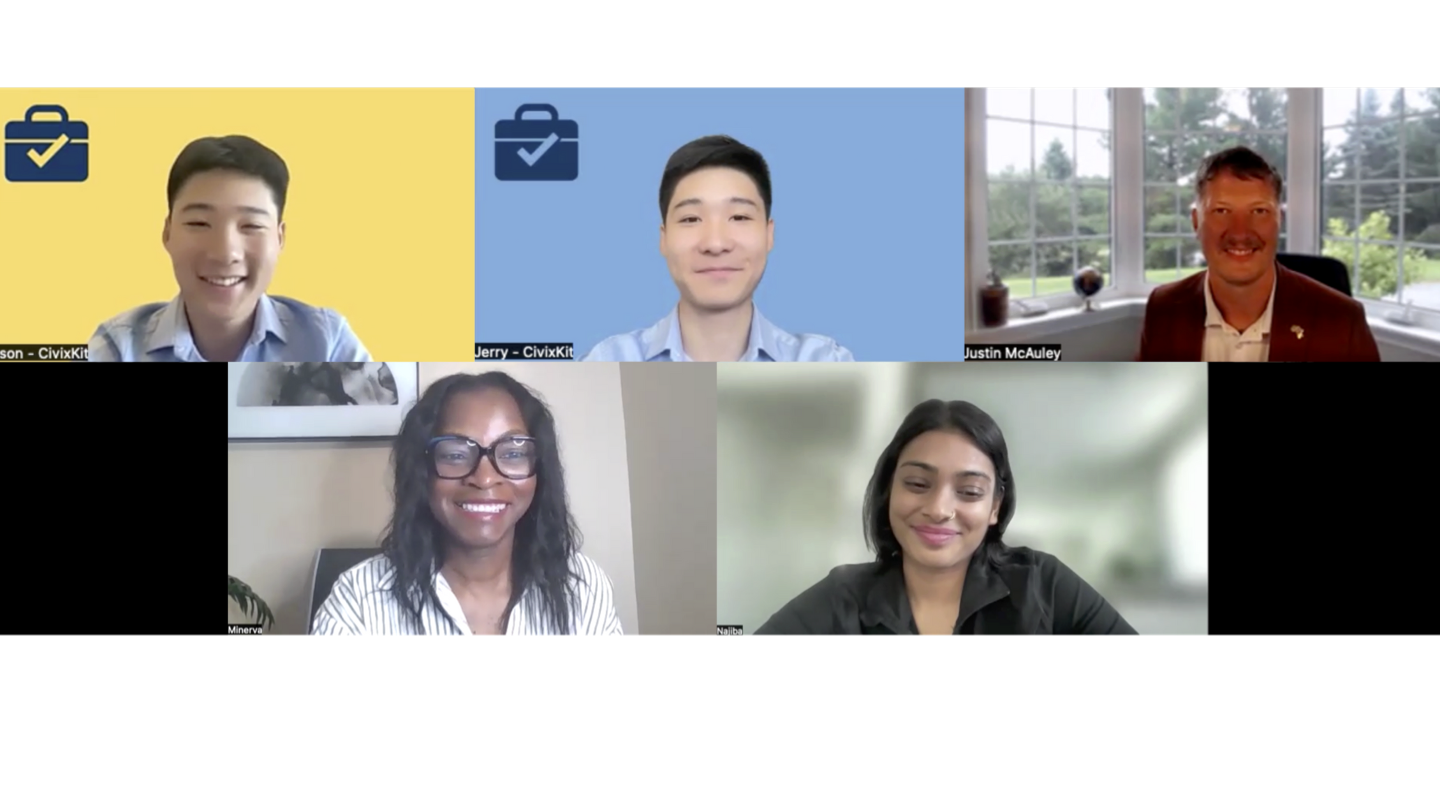
CivixKit in interview with ONE.org. With Ms. Minerva Saddler-Gray (Partnerships & Engagement) bottom left Ms. Najiba Sardar (Campaigns Manager) bottom right, and Mr. Justin McAuley (Director, North America Communications) top right.
Q: If you could give one piece of advice to first-time advocates launching a campaign, what would it be?
Ms. Sardar (Campaigns Manager)
“You can get lost in all the complexities of the process, so sometimes it's easier to just draw a map, a flow chart of where we want to be. Now, what do we need to do to get there? Rather than building ground up, go from the top down.”
Ms. Saddler-Gray (Partnerships & Engagement)
“Know your landscape. Who else is in that space that you're working? What are they doing? What are they doing well? What can you learn from? Build a network.”
Ms. Saddler-Gray (Partnerships & Engagement)
“It's not always about starting big. If you have your objective really clear and you take the time to invest in the resources that you need to achieve that through building relationships of all kinds, that will allow you to get a better knowledge and understanding of the landscaping which you're working with and a directory of knowledge and lessons that you can pull from.”
Q: How do you mobilize and empower everyday supporters into active, engaged campaigners at the grassroots level?
“One thing we talk about a lot at ONE is that we want to offload a lot of the work that we do onto our activists because we don't want to be the face of ONE, we want our supporters to be the face of ONE. So what that takes from us is making sure that they're knowledgeable and confident when talking about the issues.”
— Ms. Sardar (Campaigns Manager)
“So at the moment, we have online training that we do every month for our global activist program. But we also brought a bunch of our activists to Calgary ahead of the G7 and did a full day training with them as well. That was an opportunity for us to make sure they feel confident. We had them do policy briefs. So they learned how to … look up an issue, look at the background of it, give us some context on what happened.”
— Ms. Sardar (Campaigns Manager)
“It's a cliche, but each one teach one. I really do live by that and believe in that. It really is about sharing knowledge and empowering the people that you want involved.”
— Ms. Sardar (Campaigns Manager)
Q: Can you walk us through the anatomy of a successful campaign, from idea to execution, and what you think ultimately made it so effective?
Ms. Sardar (Campaigns Manager)
“So normally there's some type of initial conversation. Say we know something is coming up … I'll use GAVI, for example, which is when the Vaccine Alliance in Canada gears up for a pledge, which renews every five years. So you go back in time and plan it out that way. So if we know something is happening in March 2025, then we need to start campaigning, I would say, a year and a half, two years before the deadline. This is a mass campaign.”
Ms. Sardar (Campaigns Manager)
“What is it that you want? That's the main thing that you need to identify right off the bat. What's our end goal? Do we want the prime minister to commit to a certain amount? What is the certain amount? How? And then the next move is how are we going to get there. Are we going to have meetings with MPs to try to push them?Are we going to have our supporters take action? There's a million things you could do, but it really depends on what your end goal is.”
Ms. Saddler-Gray (Partnerships & Engagement)
“After the clear identification, you can go back and go. How much time do we need? What resources do we have? How can we work as a team to get there? How can we lean into everybody's expertise to make sure this happens? So, for example, with the Gavi Vaccine Alliance, we did a bunch of different things. We had our supporters send personalized letters to MP Hussein. There were mass email campaigns. There was phone canvassing. In the end, the Prime Minister did commit a pretty large amount, 675 million. So that was a very successful campaign for us.”
Q: How can grassroots campaigns without established credibility effectively secure media coverage and news attention?
“So one of the key parts that I remind folks is that media relations and government relations both have relations at their foundation. So it's a matter of building credibility with individual journalists as well as individual outlets. They are all looking for content.”
— Mr. McAuley (Director, North America Communications)
“So it's all about finding creative ways to hook your angles into the media cycle … any media hook, if you think of it through the metaphor of fishing. If you're fishing, you can have the best bait in the world. You still have to cast far more than once in order to actually get a bite. And then once you get a bite, the fish can still float off and go do something else. So to land an actual media story is the end state of a lot of effort, hustle and outreach.”
— Mr. McAuley (Director, North America Communications)
“So don't be afraid to pick up the phone, fire off emails, and don't be afraid to ask questions. Personal relationships always make a big difference, especially in today's world when things are remote, and there are A.I. tools. Reporters value human interactions first and foremost.”
— Mr. McAuley (Director, North America Communications)
Q: What’s the most sustainable way for early-stage advocacy campaigns to secure funding?
Ms. Saddler-Gray (Partnerships & Engagement)
“What I have seen is the framing and the messaging about the work that advocacy groups do is critical. The most funding will indicate that they do not support political activities in any way or any kind of association with a political party, organization, or activities.”
Ms. Saddler-Gray (Partnerships & Engagement)
“In other words, advocacy is not part of the language for funders. That's essentially what they mean, right, because most grantmakers get a lot of their resources from government as well, so that’s a really tricky place for them.”
Ms. Saddler-Gray (Partnerships & Engagement)
“I would say if the framing and messaging is around youth development or youth leadership, for example, there's some funding now that targets civic engagement. So I think how you frame it, really talking about what it means for the community in terms of inclusion, in terms of community contributions and belonging and community building, I think you have a better chance of accessing resources as opposed to leading with advocacy.”
Description: A national email campaign that mobilized Canadians to email Prime Minister Trudeau and Minister Hussen, urging a $720 million pledge to Gavi. It built public pressure and positioned Canada as a global health leader at a decisive moment.
Use Case: Best used during high-stakes decision windows, such as budget negotiations, funding renewals, or key political votes, when direct constituent pressure can influence policymakers.
Takeaway: Providing a direct template for supporters to plug and play decreases the cost of collective action and can rapidly mobilize supporters to pressure decision makers.
Newsletters
Tools
Description: A post decision supporter email sent after Canada’s $675 million pledge to Gavi that celebrated the win, outlined clear outcomes such as expanded immunization, thanked supporters, and highlighted their role in achieving it.
Use Case: Immediately after a campaign goal has been announced/achieved, to close the advocacy loop, demonstrate supporter impact, and build long-term healthy relations with policymakers.
Takeaway: Providing prompt updates to supporters is critical after a campaign win. To ensure the longevity of the moment, the win should also be paired with simple social media actions, such as #hashtag campaigns and clear next steps.
Description: A monthly e-newsletter urging action on the Gavi pledge, bolstering ethos through showcasing global attention on the issue, announcing new ONE Canada social media channels, and promoting youth delegate opportunities at the UN.
Use Case: Anytime, but is most effective when sent consistently, such as biweekly, monthly, bimonthly, or annually, to maintain regular communication.
Takeaway: A newsletter can serve as a central campaign hub, combining urgent advocacy tasks with relevant news, updates, pathways to other platforms such as new social media, and consistent opportunities to support the campaign or direct participation (e.g. the UN opportunity), keeping supporters connected on multiple levels.
Description: ONE’s in depth guide for activists on building and running effective social media channels, covering skills such as posting consistency, creating a visual brand, platform specific strategies, a first-month content roadmap, and tips for keeping momentum with analytics!
Use Case: Can be used at any time to augment social media engagement + campaign messaging.
Takeaway: Effective social media activism prioritizes consistency and clear storytelling over chasing virality. To do so, campaigns should establish a distinct visual brand (colours/icons/messaging), post regularly with intentional goals (education, engagement, action, and reflection), and follow a structured content schedule to build a sustained and engaged community.