
UNICEF is the world’s farthest-reaching humanitarian organization for children. We work in over 190 countries and territories providing education, nutrition, water and health care to create a better world for every child. And we won’t give up.
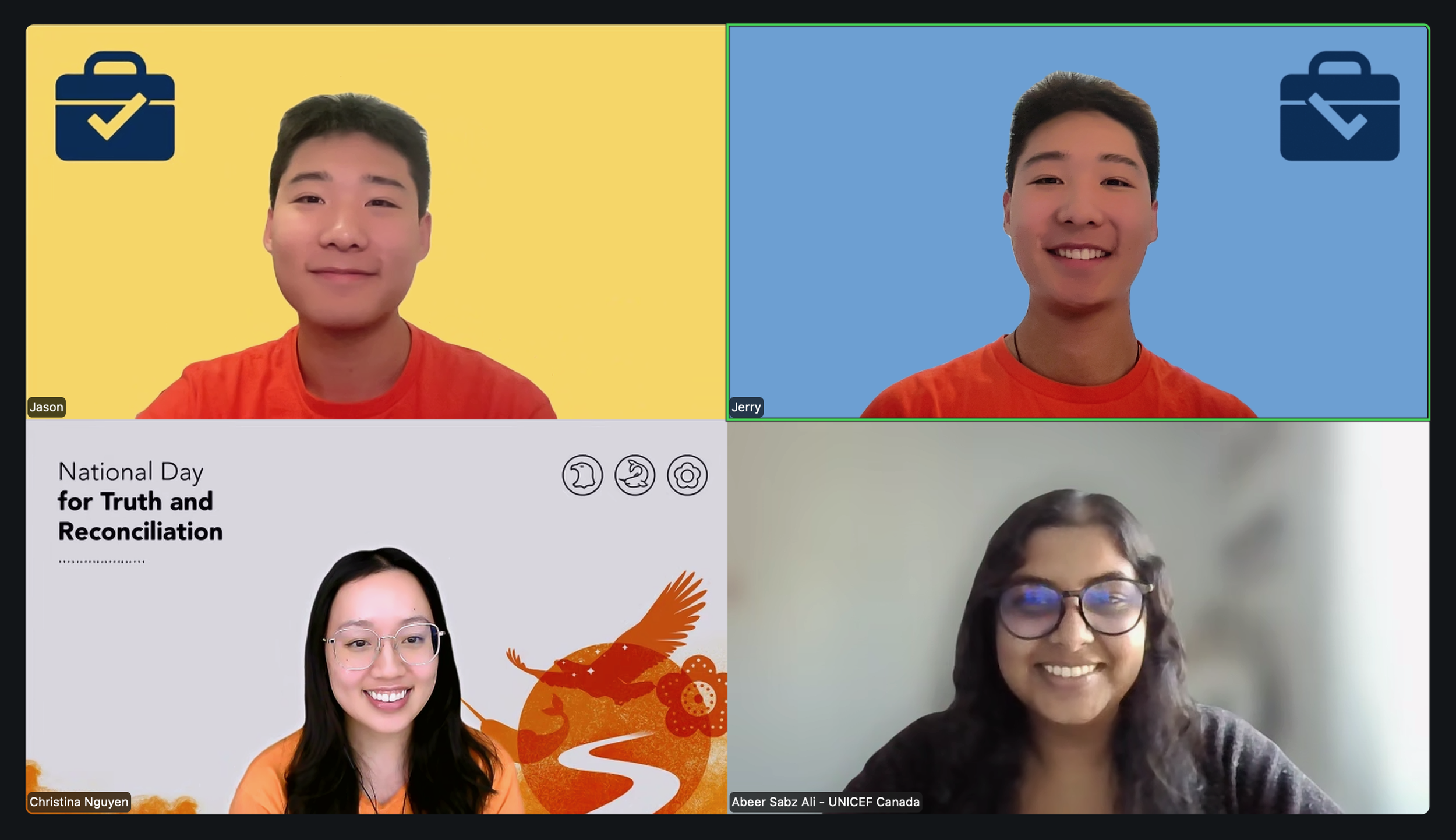
CivixKit in interview with UNICEF.
With Ms. Christina Nguyen (Senior Coordinator, Advocacy, Research & Youth Programs) and Ms. Abeer Sabz Ali (Senior Officer, Youth Programs)
Q: How does UNICEF Canada ensure that youth are not just participants, but real decision makers in shaping advocacy work? And what lessons can other campaigns take from that approach?
“So a really great example is U-Report. It’s a free, anonymous digital polling platform that’s available for youth ages 13 to 24 in Canada. It’s actually a global initiative. Speaking more specifically about the one in Canada, given that you two are based there, we send out polls every two weeks on issues that matter most to youth, whether that’s climate change, mental health, or education. We send out these polls to gather youth responses.”
— Ms. Nguyen (Senior Coordinator, Advocacy, Research & Youth Programs)“Youth can respond through three different channels, WhatsApp, Facebook, or SMS, and they share their thoughts and opinions on these topics. From there, when the polls close, we use those answers, UNICEF Canada and UNICEF partners, and feed them into some of the discussions that we have, whether that's with decision makers, the government, or community leaders. We bring youth voices into those conversations that can inform social, political, and legislative change. So it's a platform led by youth and for youth. Right now, we have around 2,900 U-Reporters and counting in Canada, and we hope to continue growing that. We love to have youth involved in our programs, and this is one of the great, very easy ways to do so. And globally, it's active in 104 countries with over 38 million U-Reporters worldwide. So those who join in Canada are part of a global movement.”
— Ms. Nguyen (Senior Coordinator, Advocacy, Research & Youth Programs)“This project, U-Report, actually started in Uganda by UNICEF Uganda as a way to provide an anonymous platform for young people to have their voices heard by decision makers. The results we gather from U-Report are also used in other reports, such as The State of the World’s Children. From this we also have a report card that comes out every year that speaks to how young people are doing in high-income countries.”
— Ms. Nguyen (Senior Coordinator, Advocacy, Research & Youth Programs)Q: Do you have any specific advice for movements and organizations focused on youth?
“First, I would like to say that we are still growing and learning. One key lesson is to ensure that young people are truly at the decision-making table in your work. Rather than designing initiatives based on what we think youth want, it is essential to actively seek their input and involve them throughout the process.”
— Ms. Ali (Senior Officer, Youth Programs)“A good example, aside from U-Report, is a project we are currently working on called the National Strategy for Food. It is a program we are advocating for to ensure that every young person in school has access to food and can learn on a full stomach. But, the entire idea is that we heard the concerns from youth, consulted youth to develop the program’s priorities, structure, and key features, such as accessibility, inclusivity, and the types of food offered, and used their input to shape how the program is designed to meet their needs in practice.”
— Ms. Ali (Senior Officer, Youth Programs)“Hopefully the next step is through our youth programs, we could give them the tools and skills they would need to help implement and better this project. None of this would be possible if we just solely implemented our belief built on research. Don’t get me wrong, research is incredibly important, but sometimes it does not fully encapsulate experience.”
— Ms. Ali (Senior Officer, Youth Programs)Q: How is UNICEF structured, and how does that structure contribute to its success? How is it able to operate across such a wide range of issues while effectively allocating resources to where they are needed most?
“UNICEF is structured globally, in three different parts. So there's the headquarters, there are national committees, and there are country offices. The headquarters, they give us guidance to support us and they kind of set the tone for the work that we do in our individual countries.”
— Ms. Ali (Senior Officer, Youth Programs)“The national committees, which include Canada and 31 other high-income countries, are primarily mandated to support fundraising in their respective countries, with those funds going toward global initiatives. However, their mandate also includes international and domestic advocacy, as well as youth programs. Within this, the domestic advocacy team focuses on local impact, including youth programs and community initiatives. This ensures that while UNICEF advocates on the global stage, it is also creating meaningful change at home, working toward its mission for every child in every context.”
— Ms. Nguyen (Senior Coordinator, Advocacy, Research & Youth Programs)“Having three levels of focus is highly effective, but our work is ultimately guided by urgency. While we maintain resources across all areas, in situations such as large-scale famine in Sudan, we concentrate our efforts where the need is most immediate. Given the current global landscape, there is always a pressing crisis, so we prioritize and allocate resources accordingly.”
— Ms. Ali (Senior Officer, Youth Programs)Noted: As mentioned above, we are still awaiting clearance on the resources. However, after our kind interviewees asked the broader UNICEF team, they identified the strongest publication in each research category. These results highlight the reports considered most comprehensive and best structured for grassroots organizations to replicate.