

Fair Trials is the global criminal justice watchdog, campaigning for fairness, equality and justice
Fair Trials serve as an international criminal justice watchdog working to expose, challenge and remedy systemic injustice in criminal processes. They oppose overcriminalisation, discrimination, disparate treatment, and marginalisation of communities. Through evidence-based research, Fair Trials support broad coalitions, where appropriate, to expose injustice and promote fundamental human rights at all stages of the criminal process.
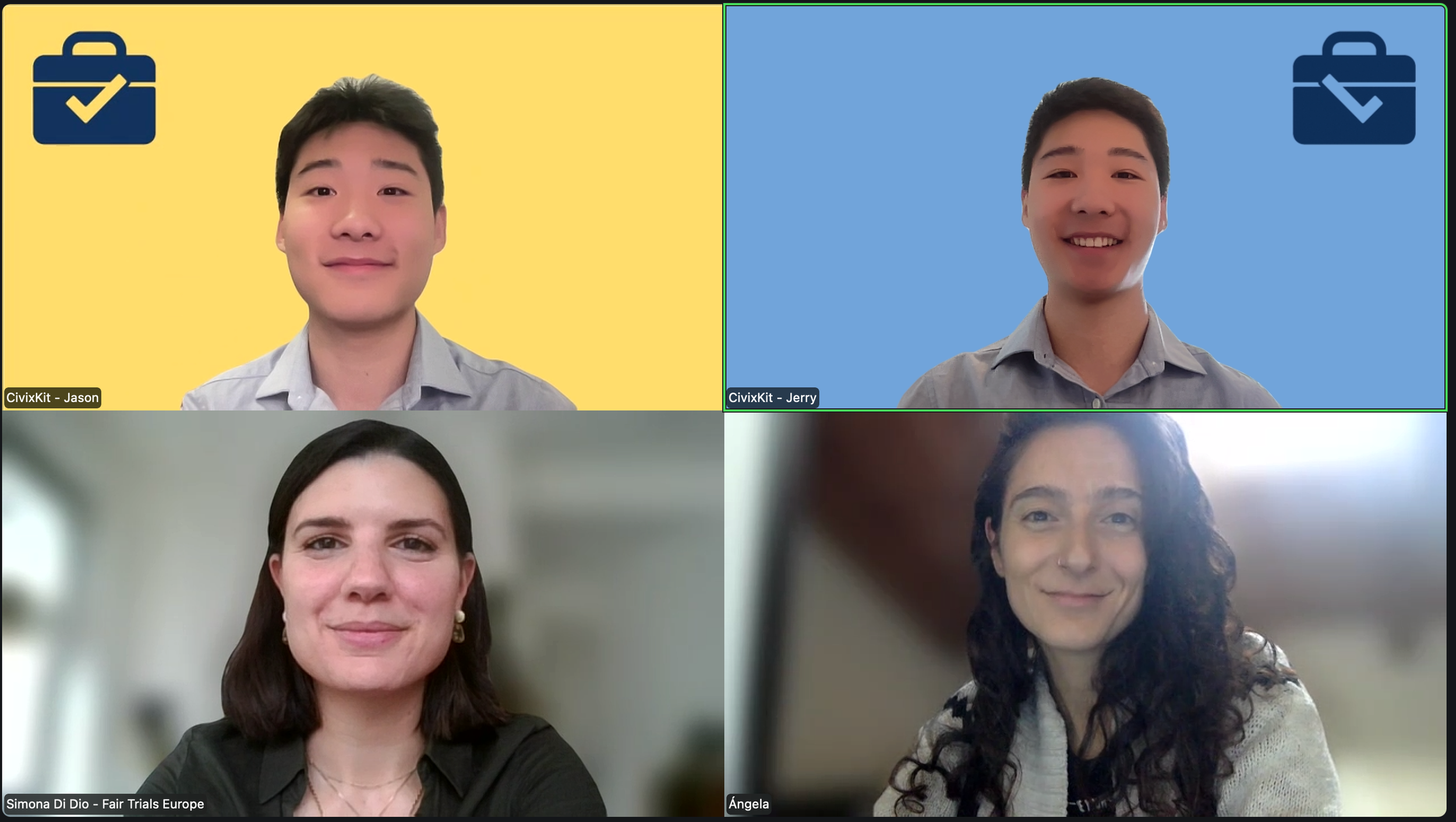
CivixKit in interview with Fair Trials Europe.
With Ms. Simona Di Dio (Networks Coordinator) and Ms. Ángela Rodríguez (Communications Consultant).
Q: For those people who might not know about Fair Trials Europe, could you just walk us through what the organization does and what are some of the impacts it aims to create?
“Fair Trials is a global organization dedicated to one simple idea. No one should lose their liberty without a fair process. We investigate how the criminal justice system really works in practice, where rights are withheld and where they quickly fail.”
— Ms. Di Dio (Networks Coordinator)
“We use advocacy, strategic litigation and partnership with lawyers, experts of the criminal justice system. Specifically with people with lived experience to push for change. So whether it's campaigning against abusive pretrial detention, calling out discriminatory policing or making sure people understand their rights when arrested, arrested abroad. Our mission is to make justice and truly just.”
— Ms. Di Dio (Networks Coordinator)
Q: Fair Trials Europe has led several impactful campaigns, from the right to counsel to extradition reform. Could you walk us through the lifecycle of one successful campaign, from initial idea to execution, and what you believe made it effective?
“So a strong campaign, I think, never starts from theory. It starts from reality. At Fair Trials, we make sure that our advocacy grows from the real needs of our members and people affected by the criminal justice system, and is always aligned with our broader mission.”
— Ms. Di Dio (Networks Coordinator)
“From the single case, we realized through conversation with our members across Europe and with partners that this was not just an Italian problem, but a systemic European problem. So we decided to include it as a major topic of our annual conference. It became a priority for our advocacy strategy, and now we are preparing a formal EU complaint against Italy before the European Commission. This campaign was rooted in a real case, powered by collaboration between our members and with another organisation, the ACBA, because we submitted the amicus curiae together with the European Criminal Bar Association.”
— Ms. Di Dio (Networks Coordinator)
“So a recent example is our campaign on the right to translation and interpretation in criminal proceedings across Europe. It all began with a concrete case in Italy because a judge referred a constitutional question to the Italian Constitutional Court about the extremely low compensation awarded to interpreters and translators during trials and proceedings. One of the LEAP network members, was the defence lawyer in that case and asked Fair Trials to intervene with an amicus curiae submission. Our argument was simple. If interpreters or translators are paid so poorly that they cannot work professionally, then the quality of the interpretation can collapse. That means it is a violation of the fundamental fair trial rights. Thankfully, the court agreed and declared the legal provision unconstitutional, and it was a big achievement.”
— Ms. Di Dio (Networks Coordinator)
“And it scaled strategically from the courtroom to policy space. So in a quick summary, it succeeded because it was grounded in a real case, strengthened through collaboration, and strategically scaled from litigation into systemic policy reform.”
— Ms. Di Dio (Networks Coordinator)
Q: Which communication strategies have you found most effective in driving action, such as social media, case studies, petitions, community outreach, or direct government lobbying, and which have you seen deliver the strongest results?
“First of all, you have to have in mind what your target audience is. Depending on who you want to reach, you have to choose different formats and language styles. The content itself can stay the same, but how you present it changes. In our case, we work with a public with an average age of 35, 40 and beyond.”
— Ms. Ángela Rodríguez (Communications Consultant)“We then communicated much more on LinkedIn. We’ve been trying different formats over the past two years to measure engagement, and LinkedIn really works. Even though our target audience is different from youth or millennials, they prefer LinkedIn to stay informed, engage with our content.”
— Ms. Ángela Rodríguez (Communications Consultant)“So what we found is that they prefer to be informed via newsletters, tailored newsletters. One of them is specific to LIB members [,the Legal Experts Advisory Panel.] We also have two main audiences: one for the entire LEAP community, and the other for selected members who attend the annual conference, chosen by the network coordinator. So we have two different newsletters targeted to them, one general and one for the conference.”
— Ms. Ángela Rodríguez (Communications Consultant)“We’ve also found that visuals attract more attention. If you use interactive visuals, like a carousel, even better, similar to Instagram. People prefer to read information in that format rather than the typical LinkedIn post where you have to read the post, then click to go to a website and read more there. Let’s be honest, our target audience are criminal lawyers. They work all day and are very busy, so not many of them click through to read full statements.”
— Ms. Ángela Rodríguez (Communications Consultant)“So what we’ve decided is to condense information directly into LinkedIn carousels. This way, they don’t miss key content that was previously only available on the website. If they want to go deeper, they can still click through and read more. Over the past two years, this is how we’ve been communicating with our members. We’ve been growing our LinkedIn community, bringing in more students, activists, PhDs, and trainees working at institutions like the European Commission. So we are not only increasing our audience, but also diversifying both age and professional background”
— Ms. Ángela Rodríguez (Communications Consultant)Q: How do you balance engaging traditional stakeholders like legal professionals with meaningfully incorporating people with lived experience, and how has that influenced your advocacy approach?
-
"From an advocacy perspective, we are now also working on our language for people with lived experience. We now have two target audiences. Our primary audience is professionals within the criminal justice system, from judges to lawyers to university professors and researchers. But we also want to engage more people with lived experience at every stage of our work. We recently, maybe one year ago now, created the EIPAC, the European Impacted Person Advisory Council. It is a group of six people with lived experience of incarceration or prosecution. They are not just consulted. They shape our fair trials strategy. We are trying to understand the language we should use on our website and across our activities, including communication and social media. But it is also much broader and more significant. They are also creating a shared dictionary and exploring and drafting ways to communicate their stories on social media in ways that resonate with others."
— Ms. Ángela Rodríguez (Communications Consultant)
-
"If you have been impacted, for example incarcerated at 18 or 20, it is not something you openly share on your TIkTok or Instagram, right? Usually you think it’s only me that this happened to. You feel afraid or ashamed. But if people begin sharing, saying this happened to me at 23, others can relate. This happened to me, it still happened to me. Because I wrote an article and I angered a French politician that is now in the government. So this politician blacklisted me and it has made my life a hell. So if people could relate and start talking then we can create a community. From that community, we can develop new projects and activities. Starting with this group of six, their experiences, vocabulary, and of course their point of view form the other side of the system to help shape our advocacy work. Together we can use the right language and vocabulary not to offend but to include them in the narrative."
— Ms. Ángela Rodríguez (Communications Consultant)
-
"The goal is to create a space where people feel safe and part of the narrative. People stay where they feel secure, especially when carrying difficult experiences. By fostering that environment, we enable them to participate rather than simply observe."
— Ms. Ángela Rodríguez (Communications Consultant)
Q: Grassroots organizations often feel pressure to do everything themselves, despite facing constraints in funding, visibility, and expertise. From your perspective, what is the most effective way for them to navigate these limitations and scale their impact?
“Even established organizations struggle with visibility, funding and capacity. So the first thing I always say is that you are not failing; the system is designed this way. What I have learned from my experience is that no organization can, or should, try to do everything alone.”
— Ms. Di Dio (Networks Coordinator)“The key is strategic interdependence: understanding what you bring to a coalition and what you can learn from others. So if a grassroots group is excellent, for example, in organizing and mobilizing people, but lacks legal expertise, they don't need to become lawyers. Instead, they can offer their mobilization power and seek partnership with legal organizations. Likewise, a legal NGO may lack connection to communities. That's where alliance with movement becomes really essential."
— Ms. Di Dio (Networks Coordinator)“The logic also applies to funding. So many grants today actually require equalization and actually the funders are increasingly looking for collaboration where each partner can contribute with a unique perspective. So my advice would be to define the core strength of the organization, communicate with confidence the capacity that the organization can provide and then build an alliance that completes the picture.”
— Ms. Ángela Rodríguez (Communications Consultant)“For organizations seeking to work in the legal and justice sector, it is important to recognize that legal expertise is not monolithic. So there's criminal law, gender based violence, environmental justice, migrants law, digital rights. Of course, there is no single person that can know and master all these sectors of the law. So it's better to ask, for example, to a specific organization that focuses on one of these specific sectors. And that's why networking is not just desirable, but is also survival. Again, if your team lacks legal expertise or experience, you don't need to all become lawyers, reach out, reach out, reach out.”
— Ms. Di Dio (Networks Coordinator)Q: Partnerships are clearly central to effective advocacy, whether with legal experts, organizations, or people with lived experience. How do you build and sustain these partnerships, and how should newer campaigns without established credibility approach forming them?
Q: What practical steps can grassroots organizations take to start building relationships and getting noticed in the advocacy space?
“Another critical aspect that is often overlooked is personal networking. Especially in places like Brussels, where the European Commission and where we are based, a strong way to build connections and actually know people is by attending conferences and events and starting conversations. Suggest a quick chat or a coffee and begin building relationships in that way. Across Europe, this is how not only NGOs, but also journalism, media, and communications operate. Approach people, start conversations, and follow up, even if they do not respond to your initial email. If they do not reply, go to the event, attend the conference, and connect in person.”
— Ms. Ángela Rodríguez (Communications Consultant)
“Start the real conversation. First, establish your goal when approaching a person or organization you would like to work with. That goal may simply be to introduce yourself and make your work known or simply to show that we exist. This kind of visibility matters. I mean now all around the world, I’m seeing everyone adding everybody on LinkedIn, exchanging emails, or following a collective newsletter. The key is to stay present without immediately pushing for something, positioning yourself so others know who you are. Step out of your comfort zone, attend events, conferences, and webinars, and actively engage. The bottom line is to get out there.”
— Ms. Ángela Rodríguez (Communications Consultant)
Q: From your experience, what are the most effective and sustainable ways to secure funding? Are grants, corporate partnerships, or other models most effective?
“Diversification is the golden rule when it comes to funding. In Europe, it is very common to rely on grants, particularly from the European Commission, and for many projects, these are essential. Some NGOs can sustain themselves almost entirely through project-based funding, although this varies widely across regions. Larger organizations may also benefit from foundation support, including multi-year grants, which provide greater stability.”
— Fair Trials Team
“At the same time, smaller donations, including recurring monthly contributions, are equally important because they can scale over time and create a more reliable base. The key is to combine different funding sources rather than relying on a single stream. Grants, for example, are valuable because they allow organizations to focus on specific projects, but they should not drive the mission. It should always start with an idea, and then funding is sought to bring that idea to life, not the other way around.”
— Fair Trials Team
“It is also important to remain mindful of independence, especially for non-partisan organizations. Human rights organizations, in particular, are often cautious about accepting corporate funding, as it can raise ethical concerns. While some corporations and public institutions offer project-based funding, each opportunity must be carefully evaluated. These decisions are rarely made by individuals alone; they typically involve the board and a structured internal process. The guiding question is always whether the funding aligns with the organization’s values. That is the foundation for any sustainable and responsible funding strategy.”
— Fair Trials Team
Comprehensive EU Law Resources
Description: This is a curated resource guide published by the Litigating to Advance Defence Rights in Europe (LADRE) Project, compiling EU law, directives, toolkits, handbooks, and reports relevant to the procedural rights of suspects and accused persons in criminal proceedings across the EU.
Use Case: The guide is intended for defence lawyers, legal advocates, and anyone seeking to understand EU standards governing suspects' rights. It serves as a practical entry point into the legal frameworks, case law, and tools covering procedural rights across EU jurisdictions, particularly in cross-border and European Arrest Warrant cases.
Takeaways:
Resources are organized by right, not by source. Each section corresponds to a specific procedural right, interpretation, information, access to a lawyer, legal aid, presumption of innocence,making it easy to go directly to the relevant materials for a given case issue.
Practical tools sit alongside academic and policy resources. Each section mixes toolkits and training modules for practitioners with research reports and comparative studies, serving both immediate litigation needs and deeper legal analysis.
Right to Interpretation & Translation Toolkit
Description: A legal guide focusing on the right to interpretation and translation in European Arrest Warrant (EAW) proceedings. It covers the relevant EU legal standards, real-world implementation challenges, and step-by-step practical guidance for ensuring these rights are effectively safeguarded in cross-border criminal cases.
Use Case: Geared toward defence lawyers and legal advocates, this toolkit clarifies how interpretation and translation rights function in cross-border criminal proceedings, especially where the requested person does not speak the language of the executing Member State. It serves both as a litigation resource and a practical guide for identifying and challenging violations of these rights in European Arrest Warrant cases.
Takeaways:
The legal standard is established before the practical guidance begins. The toolkit first sets out the relevant EU Directives and ECHR case law before moving to implementation challenges and what lawyers should actually do, so readers always understand the legal basis for any action they take.
The burden of proof falls on the authorities, not the requested person. It is not for the individual to prove they do not understand the language; rather, it is for the authorities to demonstrate that they do, and to provide reasons if they decide that no interpreter is needed.
Legal Aid ToolKit
Description: A practitioner's toolkit focusing on Directive 2016/1919 on the right to legal aid for suspects and accused persons in criminal proceedings and in European Arrest Warrant proceedings. It covers the legal framework, scope, conditions of access, quality standards, and practical guidance for using the Directive in domestic courts.
Use Case: This toolkit supports practitioners handling criminal and European Arrest Warrant proceedings across the EU by clarifying how the right to legal aid applies, with particular relevance for those representing or advising individuals in such cases. It serves as both a litigation reference and a practical guide for challenging national laws or practices that fall short of the standards set by the Directive.
Takeaways:
The right to legal aid is framed as the gateway to all other fair trial rights. It expresses how without this right, all subsequent rights, whether right to interpretation, information, and access to a lawyer become theoretical.
National courts can be pushed further than they think. The toolkit repeatedly shows where domestic law has incorrectly transposed or narrowly applied the Directive, and gives lawyers the specific arguments, case law, and EU law principles needed to challenge those gaps directly before national judges.
Judicial Review Guide
Description: This is a focused legal guide examining the right to judicial review in European Arrest Warrant proceedings. It analyses the scope and limitations of judicial oversight at both the issuing and executing state levels, the structural flaws in the current EAW system, and how lawyers can challenge disproportionate or unlawful warrants within those constraints.
Use Case: This guide is most useful for those litigating or advising on European Arrest Warrant cases where the scope and limits of judicial review are likely to be contested. It is particularly useful for practitioners working across both the issuing and executing states who need to identify when and how to challenge a warrant before surrender becomes irreversible.
Takeaway: The EAW system is structurally designed to exclude the defence until it is too late. In the vast majority of Member States, neither the national arrest warrant nor the EAW itself is issued through an adversarial process. This directly means rights violations are often locked in before a lawyer is ever appointed or heard.